Are you curious about trying the carnivore diet but not sure where to start? Are you feeling frustrated with your carnivore diet results, or perhaps unsure if you’re doing it right? Look no further! This post is for you. Dive into this enlightening discussion with Kelly Hogan, a seasoned veteran of the carnivore diet for 14 years.
In this post, Kelly shares her invaluable insights on weight loss, macro counting, and navigating dairy sensitivity on the carnivore diet. Don’t miss out on the wealth of knowledge Kelly has to offer after years of experience and discover tips and tricks from a true carnivore diet expert, insights to master the carnivore lifestyle and achieve your desired results.
Enjoy the insightful YouTube video featuring Kelly Hogan, where she shares her expertise on the carnivore diet. Watch it to gain valuable tips and guidance on navigating the carnivore diet from a seasoned pro. Don’t forget, the full interview is available below for further reading.
Top Tips From A 14 year Carnivore Diet Pro Kelly Hogan
Q1: Can you share the story of how you began your journey with the carnivore diet? What led you to explore this way of eating?
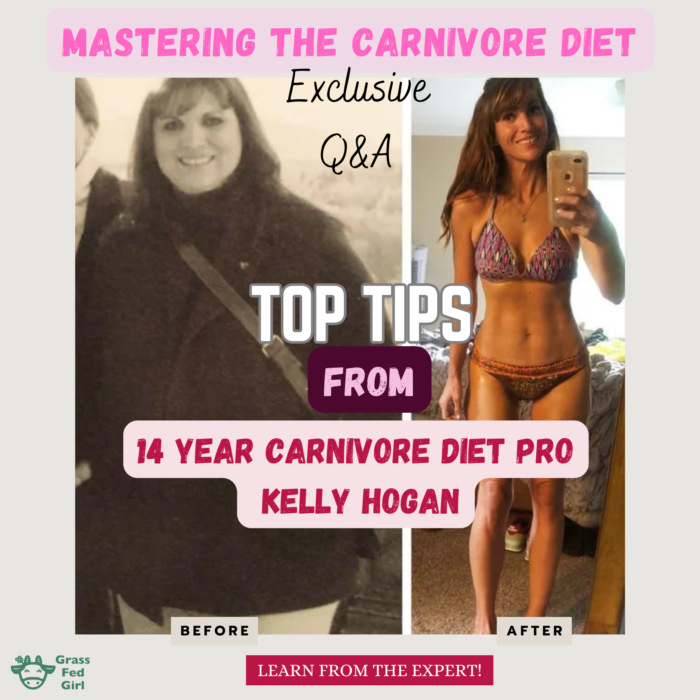
Kelly Hogan: Caitlin, seriously, it feels like ages ago, but let me show you a picture. I clearly remember a photo taken 19 years back, during my time at Bible school. It’s hard to believe it’s me sometimes. At that point, I was struggling with cellulitis in my leg, weighed 262 pounds, and felt far from healthy or comfortable in my own skin. I was constantly battling deep seated boils and chronic inflammation, clueless about the cause.
My doctor’s diagnosis was a wake up call: excessive carbohydrates were fueling the inflammation. So, he issued me a challenge: one year of eating nothing but meat, with a nod to leafy greens and eggs. No fruit, pasta, starches, or anything sweet. It was a drastic shift from my cereal-loving, fat-free diet days. But I took the plunge, and within that first year, I shed 80 pounds, bid farewell to chronic acne, and said goodbye to those pesky boils for good. It wasn’t an easy journey, but it was transformative, and it all started with that photo and a moment of realization of how far I’d strayed from health.
Q2: You mentioned transitioning from a diet heavily reliant on cereal and fat-free products to the carnivore diet. Can you share more about what your typical diet looked like before making this shift, and what prompted you to make such a drastic change?
Kelly Hogan: My previous diet was a far cry from the carnivore lifestyle I now embrace. It revolved around convenience and low fat products, with cereal and fat free dairy products taking center stage. I grew up in a household where fat free was the norm, from skim milk to fat free Cool Whip on cereal. It was a diet high in carbohydrates, low in nutrient dense foods, and devoid of satiating fats. The turning point came when my doctor diagnosed me with excessive inflammation caused by carbohydrates. That revelation, coupled with years of struggling with my weight and health issues, propelled me to make an entire change in my dietary approach. And thus began my journey into the world of carnivores.
Q3: What were some of the challenges you faced during your transition to the carnivore diet, and how did you overcome them?
Kelly Hogan: Transitioning to a carnivore diet wasn’t without its hurdles. Giving up my beloved cereal and embracing a meat centric lifestyle felt like a huge shift. But the biggest challenge was probably overcoming the ingrained belief that calories were the enemy. Dr. Dunlap’s advice to eat as much meat as I wanted, without counting calories, was a game-changer. I asked him about how many calories I can eat because I was such a Dieter I tried dieting so many times and it always involved calories. He said I don’t care but he did give me a piece of paper he said if it’s on this side of the paper eat as much as you want if it’s on this side of the paper don’t touch it. So, it required a mindset shift from restriction to nourishment. Over time, as I saw the pounds drop and my health improve, those challenges paled in comparison to the benefits of this way of eating.
Q4: What are some of the most significant health benefits you’ve experienced or witnessed among those who adopt the carnivore diet?
Kelly Hogan: The changes were truly remarkable. Within that first year, I bid farewell to chronic inflammation, shedding 80 pounds and waving goodbye to chronic acne. But beyond the physical transformations, there was a profound shift in how I felt.
Q5. Can you share how you transitioned from a low carb diet to discovering carnivore groups, and what pivotal moments led you to this zero carb lifestyle?
Kelly Hogan: After my initial consultation with my doctor, I embarked on a low-carb journey, initially inspired by Atkins’ approach. However, I found myself struggling with carb cravings and lacking guidance on prioritizing fats in my diet. Five years into this journey, I turned to the internet, seeking answers and validation for my carnivorous way of eating. That’s when I stumbled upon Charles Washington’s “Zeroing In On Health” group, where I found a community of like minded people, including Dana Spencer, Dr. Lisa Wiedeman, and Amber O’Hearn.
Sharing my before and after photos with them was a turning point. They recognized my zero carb lifestyle. I mentioned that although I felt generally okay, I could use a bit more energy, and I expressed that the hardest part for me was avoiding sugar. It was a moment of realization when they questioned why cutting out sugar was difficult after five years on this journey. I confessed to still consuming diet sodas, sugar free Jell-O, and candies, like breath mints. Their response was eye opening, they pointed out that these sweeteners were keeping my brain’s sweet receptors active, perpetuating cravings. Despite my initial resistance, I decided to consider their advice and cut out sweeteners entirely. The transition was tough, and I experienced three challenging days without them. However, by the fourth day, I noticed a significant improvement, and each subsequent day brought a remarkable transformation.
I maintained constant communication with the group, finding invaluable support and guidance. This pivotal moment marked a shift towards a more committed carnivore lifestyle, which became significantly easier and sustainable except when I was pregnant. That was not easy but otherwise that was a big game changer. The group emphasized the importance of prioritizing fats in the absence of carbs, enlightening me on the role of fatty meats for sustained energy. Their insights and encouragement were instrumental in refining my dietary approach and embracing a truly carnivorous lifestyle.
Q6: Can you share your experience with maintaining a carnivore diet during pregnancy, considering the conventional advice for expecting mothers to eat a varied diet with more carbohydrates?
Kelly Hogan: I had been a carnivore for about 10 months when I found out I was pregnant. I was so excited! And I was like oh my gosh, you don’t want to ruin this, and yet you’re eating so differently, completely opposed to what everyone says you’re supposed to do when you’re pregnant—eat the rainbow. But there’s no rainbow, it’s just different shades of brown and red, right? And I was not even doing dairy before I got pregnant, and then meat aversion set in. So I couldn’t even eat what I thought was best as a carnivore, which was really, medium rare to rare beef, is what I consider to be best, good fatty beef. Well, I could not even do that, I could not stomach it. So, I used to eat bacon and sausage, eggs and cheese. That was not even what my doctor recommended.
“My diet was not meeting the typical expectations or standards, particularly those recommended for pregnant women, but it still reflects a commitment to the carnivore approach. It was subpar carnivore, that’s what I was giving my baby and it felt scary. And I was voicing these fears frequently to the Zeroing In On Health people”.
Charles Washington said, “You’re a human.” “Yes,” I said, “Yes.” “How much better do you feel eating this way?” “So much better,” I said. “So it turns out all of that fiber was unnecessary for you, correct?” He was like, “What is growing in your belly right now, human or not human?” “It’s a human, Charles. I really hope it’s a human.” Like, can we at least start with the assumption that little humans are going to fare better on a diet that big humans fare better on?
So, in my first trimester, every time I was not this super squeaky clean, red meat only carnivore because my body was just sort of screaming against it, but I was able to. I ate a lot of eggs, eggs tasted great to me, bacon and sausage, burger patties as long as it had cheese and hot sauce. Everything had to have hot sauce, basically. And I made it through. But it is a scary thing because it’s not like I had a lot of other people in my life to say, “Oh, that’s exactly how I ate when I was pregnant.” I had nobody saying that to me. No one.
Q7: That’s incredible! I suppose your children are healthy and thriving. Well, as normal as kids can be, right?
Kelly Hogan: Absolutely, they’re wonderful. They’re active and bright, little athletes and smarty pants. I’m proud of them. They’re great kids.
Q8: That’s impressive. It must have taken a lot of determination to defy conventional wisdom and stick to your own path. So, moving forward, a couple of years ago, you started following an 80/20 fat to protein ratio. Is that still part of your routine?
Kelly Hogan: For those unfamiliar with it, the 80/20 ratio means 80% of daily calories come from fat and 20% from protein. I rigorously adhered to this for five months to gauge its effects on my body. While my health markers remained positive, the strict regimen became tiresome. I experimented with various fat sources, from butter to beef tallow, but ultimately, I returned to a more flexible carnivore diet. Now, I eat intuitively, focusing on a balance of meats and fats.
Just whatever macros show up, it’s good. I do have a general rule for myself and for people that I work with. If you’re a total carnivore, I want to see fat between 60 and 80 percent, unless you’ve got a really good reason to be otherwise. For example, if you’re taking a day to do a certain type of fast, like a PSMF day or a water fast, obviously you’re going to hit 60 to 80 percent of calories from fat. But for most days, I do think most people should keep their fat between 60 and 80 percent. Also, if you have a reason that you need to stay in therapeutic ketosis for epilepsy or for depression, go higher than 80 if you need. But I feel like if most people keep it higher than that for an ongoing time, then they may be lower on protein than they should be. So, 60 to 80, as long as I’m there pretty much every day, I feel very comfortable with that.”
Achieving around 60 to 70 percent fat intake seems quite feasible as that’s the natural fat content in meat. To fall within the 60 to 80 percent range, you’d have to deliberately choose lean cuts like skinless, boneless chicken breast or intentionally avoid adding fat to your meals to dip below 60 percent. I’m in alignment with that understanding now.
Q9: Did you notice any significant changes during those 5 months?
Kelly Hogan: Despite already being at my goal weight, I did experience some weight loss and also gained muscle because I was weight training at that time. However, when you’re consuming sufficient meat and engaging in weight training, muscle gain is expected regardless of whether your diet is high in fat or not. I was also involved in CrossFit exercises, which contributed to my muscle growth. Contrary to some beliefs, I found that I could still build muscle mass on a high-fat carnivore diet. My energy levels were good, and my lab results were impressive, with notably low triglycerides and elevated HDL levels, reaching the 80s compared to the typical 60s I usually see on a standard carnivore diet. Exercise also played a part in my improving HDL.
Q10: So when people do carnivore, should they worry about macros, especially when they’re starting out? Should they just forget about it for a while, or is it important to do that?
Kelly Hogan: Alright, I think in the very beginning, there are bigger issues. Issues such as breaking sugar or carb addiction for a lot of people, there are issues like how to deal with your family, how to go out to eat, how to live with a carb eater next to you. You’ve got bigger fish to fry, maybe literally, than dealing with where your macros are. But when somebody comes to me, even if they’re in week three or something, fairly new, and they say, “I’m not feeling good,” I’ll typically say, “Well, you know, you’re going through a big adjustment. There is an adaptation period, but it’s also very possible that you’re eating very low in fat, lower than 60%, or that you’re under-eating, which will make you feel like trash on any diet. So there are reasons to look at it even in the early stages, but I usually recommend that people deal with those bigger things first—the addiction, the social aspect, getting just used to this, dealing with the bathroom changes because sometimes gut issues take a while—versus I’m going to need you to hit any particular macro. But I do think if someone is able and willing to track, the general recommendation of just taking a peek at that fat chart, making sure you’re staying 60 to 80ish, is a good ballpark. But as we said, most all meat falls there anyway, so maybe the general advice should just be, “Don’t do anything weird, man. Just eat meat that tastes good. Don’t make it weird.” Yeah, don’t.
I don’t encounter people who overthink, especially among women. Let’s say maybe 10% of every group member that I work with is probably a newbie to carnivore. The vast majority have been doing this for a while are troubleshooting. That’s why I frequently say, “Hey, let’s track that,” because I can’t help you solve problems if we don’t even know what you’re doing. If you have no idea how many calories you’re even eating a day, you have no idea. Let me teach you how to figure that out so we can help solve the issue. But if there’s no issue or you haven’t even started, then no, that’s not what I’ll lead off with.
Q11: I’ve noticed that many people seem to struggle with dairy consumption. Do you agree? What advice do you give regarding dairy to the groups you work with?
Kelly Hogan: Well, it’s a universal truth that humans love cheese. Whether they’re following a vegetarian, carnivore, or standard American diet, cheese is universally adored. When people learn about an all meat or all animal products diet, they often ask, “Can you have cheese?” My response is always affirmative, which usually provokes wide eyed excitement. However, while cheese can be enjoyed, I emphasize that it shouldn’t dominate our diet. Instead, the focus should be on fresh meats, not cured processed meats. For many people transitioning from a diet heavy in sandwiches, pasta, donuts, and pizza, adding cheese to their meals, especially alongside steak, represents a significant improvement. However, when troubleshooting stalls or obstacles, excessive cheese consumption, especially when combined with heavy cream in coffee, can sometimes hinder progress. Dairy sensitivities are common, and if someone is sensitive to a particular food, it will likely cause issues regardless of what that food is. Therefore, I advise individuals to assess whether dairy is working for them.
Recently, a woman who had been stalled in her weight loss journey decided to eliminate dairy from her diet at the beginning of this year. Since then, she has lost 17 pounds and reports feeling better overall. Sometimes, weight loss may not occur immediately, but improvements in how one feels can be a positive sign. In such cases, I encourage individuals to continue with what’s working for them, as weight loss may occur over time.
When someone tells me they’re frustrated because they’ve given up everything else and now they can’t even have dairy, I ask them to weigh their frustrations. What’s more aggravating: the unresolved issues like weight or joint pain, or the frustration over cutting out dairy? If cutting out dairy seems more manageable, then it’s worth it. But eventually, most people reach a point where they realize that the frustration of holding onto dairy outweighs the benefits, and they give it up to see how it goes. You never know until you try.
Additionally, I advise people that if they reach a weight they’re perfectly comfortable and happy with and the only reason you’re avoiding dairy is weight related issues, perhaps reintroducing dairy in moderation could be part of their maintenance lifestyle. Personally, I still add a tablespoon of cream to every cup of coffee, and it works well for me at this stage. When I first began the zeroing in on health journey in 2009, dairy wasn’t included; it was strictly beef-only. During that initial ten-month period until my pregnancy, I completely abstained from dairy. While it was somewhat disheartening, I was surrounded by a supportive community that shared the same dietary principles. It felt like these were my people—we avoided dairy and sugar, and our love for beef was unwavering. Back then, it didn’t feel as sad as it would to me now.
Caitlin Weeks: Well, I think you also need to find a way to moderate it. Can you limit yourself to just one tablespoon? Lisa talks about having sober behavior around cheese or heavy cream. If you can do that, it might answer whether you can handle it or not.
Kelly Hogan: When it comes to the liquid cream in my coffee, I’m pretty disciplined—I stick to just one tablespoon. But then, for Christmas, my kids got this canister where you pour in heavy cream, screw on the lid, and attach this little nitrous oxide cartridge. It turns the cream into whipped cream, and it’s like, “Oh my gosh, I’m not sober, I’m a total addict again.” I find myself thinking about it, it’s in my fridge just tempting me. If I wake up in the middle of the night, I am tempted to indulge. It’s the same product, just heavy cream, but the form it takes changes everything. It’s like the fat-free Cool Whip and it brings back all those feelings for me.
Q12: What are some of the mistakes you commonly observe in your groups?
Kelly Hogan: The most prevalent one is that people don’t experience hunger like they used to. They’ll often say, “I’m not hungry, I eat until I’m satisfied.” Just the other day, a grown man told me, “Kelly, I eat until I’m full, but I’m not sure if it’s enough food.” My initial reaction was, “Well, if you’re eating until you’re satisfied, that’s fantastic, good job.” But then I asked him how he felt and how his results were. He admitted he wasn’t losing much weight. So, I asked him to share what he typically eats in a day. He said he only drinks black coffee for breakfast, has four quarter-pound beef patties for lunch, and skips dinner because he’s not hungry. I pointed out that this totals just 880 calories a day. When I asked if he snacks, he said no, he feels full. There lies the issue—we can’t sustain ourselves on such low calorie intake. Despite feeling full, he lacks energy, isn’t losing weight, and is essentially starving without realizing it. It’s because we’re accustomed to the hunger pangs of carb addiction, where blood sugar drops and we feel hangry, needing to eat every few hours. So, when we analyze what people are actually eating, they’re often consuming far less than recommended. I’d say that’s the most common mistake.
I have never encountered that issue. I am pretty convinced I’ve never been in a food eating contest, but I think I would excel at it, actually. You know how sometimes in a food eating contest, it’s all these big guys, and then there’s this one petite woman who shows up and beats them all? I think that could be me. Like the Nathan’s Hot Dog contest, where there’s this tiny Asian guy who eats all the food. Yes, I love to eat, and I can really put away a lot of food. I always have. It was a problem when it involved carbs, but it’s working out for me now.
Q13: Do you find that when dining with carnivores, you observe differences in eating habits? For instance, while I can manage for a while, I’m not like an OMAD person who can finish the entire meal in one sitting. I tend to prefer two meals.
Kelly Hogan: I eat three times a day, so honestly, if it’s down to just one meal, I would struggle too, truth be told. I do consume a lot throughout the day. But, like, I have had meals with Bella, the steak and butter gal, and I just can’t match her pace in one sitting. She’s impressive, though, and I bet she would win any eating competition. But, she doesn’t eat three times a day like I do. So, overall, I do end up eating a substantial amount of food throughout the day.
Q14: Do you have any advice for fellow carnivores based on your experiences?
Kelly Hogan: Alright, listen up everyone. I know when you’re starting out, it can feel overwhelming, like every hour is going to be a struggle forever. I remember those shaky, sweaty moments, tempted by snacks that used to be part of my routine. But if you can push through those tough first days, nourish yourself, take walks, find supportive people, even if it’s just online, you’ll start to see the benefits. Keep hope alive, silence that negative inner voice, and remember, you’re not meant to thrive on toxic junk. Reflect on your progress, no matter how small, and let it drive you forward. It may not be quick, but it’s worth it. Relax, nourish yourself, and know that you’re doing amazing things for your body.
Caitlin Weeks: That’s fantastic! I believe you are making a significant impact, helping countless individuals. I hope this insightful talk will undoubtedly find its way to those who truly need it. Be sure to follow Kelly at “My Zero Carb Life” for more valuable insights on her YouTube channel. Thank you immensely, Kelly.
And to my readers, please leave a comment if you resonate with our discussion. You can read about my 30 day carnivore keto diet experiment results here.
Are you tired of gaining weight every time you stop counting calories, carbs, or tracking macros?
Do you feel stressed with frustrating calorie counting and macro tracking in popular diets?
Master the Carnivore Diet with my comprehensive 30 Day Carnivore Diet Challenge eBook!
Get ready to unlock all the answers to your burning carnivore questions. Whether you’re a beginner or seasoned carnivore, this eBook has everything you need to succeed on your carnivore journey. Don’t miss out – grab your copy now!


